Scotland’s Scone Palace: A Wealth of Regal History

How difficult can it be to locate a water nymph in a fountain? Between myriad copper and green beech trees – 2000 to be specific, all maddeningly grown to thwart human progress – it is proving trickier than I’d thought. Welcome to Scone Palace’s unique tartan maze.

Escaping from 800 meters (2600 feet) of hedged, right-angled paths lies with seeking the highest point – in this case, the bridge.
From here, I have a clear view of the water nymph, the Palace with its immaculate gardens, and, thankfully, the maze’s exit into the towering conifers of the Pinetum.
From this elevation, a whir of flapping catches my eye. A brace of peacocks launch themselves over an ancient village wall, clipped wings thrashing to maintain forward propulsion.
A mildly distressed squirrel rockets up a tree while the duo continue their sylvan journey, necks bobbing rhythmically back and forth.
Ambling through the immaculate Woodland Garden brings me to a bucolic behemoth: the Douglas Fir. This wonderfully jaunty tree – its single, rakish branch looking as though it was designed to amuse children – nobly ranks among Britain’s fifty most notable trees. Botanist David Douglas (who once worked as a gardener here) sent the seedling from America in 1826.

A Fatuous Solution
Rhododendrons and azaleas herald the former Augustinian Abbey gateway, and a view of the ivy-clad Palace.

For the Earls of Mansfield, however, this view became a source of disquiet.
In 1773, the querulous Second Earl began to tire of the Palace’s proximity to the village of Scone, complaining that the villagers “come up almost to my doors.”

Thirty years later, the Third Earl’s landscape gardener suggested a marvellously fatuous solution: move the village!

The Murray Star Maze and water nymph.

In 1805, every building was knocked to the ground, and 1400 villagers shuffled – burdened under belongings – two miles to the village of New Scone.
Today, remnants of stone buildings still abound in the Palace grounds, which, incidentally, are the best-known breeding locality for hawfinch in Scotland.

Scone’s claim to fame, however, is as the coronation site of Scottish kings and parliaments.

Robert the Bruce was crowned in Scone in 1306. And Charles II, in 1651, was the last to accept the Scottish crown here.

Before even these early kings entered the stage, however, there sat a special stone on this site: the Stone of Scone.Acting as the “crowning seat” throughout the ninth to thirteenth centuries, the Stone’s history is cloaked in mystery and skulduggery, its authenticity seriously in question.

The water nymph at Scone Palace.

Today the visitor is faced with a 26-inch replica – a stoic testimony to a wealth of regal history. From this vantage point atop Moot Hill, the vista over Perthshire unfolds.
Also known as the Stone of Destiny, the original oblong block of red sandstone – said to be the pillow stone for the Biblical Jacob – has had a chequered past.

From 1296, the facts to the true Stone’s whereabouts become a little sketchy.

Edward I of England filched the legendary rock, transporting it to Westminster Abbey in London. But was he fobbed off with a facsimile?

The Stone was then fitted into a wooden chair in Westminster Abbey, upon which every English monarch has subsequently been crowned, except three: Queen Mary I&II and King Edward VIII.

But had the English troops been fooled into taking a substitute in the thirteenth century? Nobody will ever know.

Scone Palace Douglas Fir
This Douglas fir was sent from America as a seedling by botanist David Douglas.

From Christmas day, 1950, the Stone’s true location became even more baffling. What is certain, however, is that four Scottish university students conducted the most daring of capers, right under the noses of England’s finest detectives.
Armed with nothing but a crow bar and a clapped-out getaway car, they returned the Stone – now showing signs of fragility, and broken into two pieces – to its homeland, successfully evading roadblocks at the border with Scotland.

The story of the raid has now been converted into a film: The Stone of Destiny.

Just a few months later, the Stone – if indeed, it was the same one – was discovered on the altar of Arbroath Abbey. London police returned it to Westminster, amid rumours that it had been copied, while being repaired, by a Glaswegian stonemason.

The Stone of Destiny, since 1996, has purportedly resided in Edinburgh Castle – alongside the Crown Jewels of Scotland.

Provision has been made for the Stone to be transferred back to Westminster when required for future coronation ceremonies. Whether genuine or ersatz, the Stone of Scone was last used at the coronation of Elizabeth II.

The Stone of Scone on Moot Hill

The Palace, like the Stone of Scone, has had an eventful life, though the Palace of today was only built in 1802. It once bustled with forty staff – this, in 1842, when Queen Victoria visited – and in the ’40s it was occupied as a girls’ school.
Loathsome adolescents subsequently set the Palace on fire – twice. Extinguishing the infernos has irredeemably damaged the silk brocade wall-coverings in the Drawing Room. Sunlight has added to their deterioration.
Attempting swift progress through the numerous staterooms open to visitors, I am forcibly impeded. A hunched lady with thinning hair has come to assist me, bristling with platitudes and inveigling me to look at photographs of monarchs.

As I doggedly edge out of the Library, eyeing a magnificent bed canopy – complete with royal coat of arms, no less – she clutches an arm peremptorily.

“We will soon be performing The Faure Requiem – most uplifting,” she says loftily, referring to the efforts of her local choral society.

I detach myself and take a closer peek at a magnificent child’s Sedan Chair, constructed entirely from papier mache.

Villagers’ view of the Palace

Exhibits are on a grand scale in Scone Palace: the bed furnishings in the Ambassador’s Room are French damask silk and took seven years to construct; Boulle cabinets in the Drawing Room are inlaid with tortoise shell and overlaid with designs in brass, pewter and copper; and the Long Gallery, at almost forty-five meters, is the longest room in Scotland.
In poor weather, visitors would once have taken exercise here – a quick stroll to maintain one’s constitution. The garishly stuffed bears (holding donation plates) and mounted elephant skulls in the Inner Hall, however, do little to maintain mine.
As I leave, the gatekeeper is wearing a kilt. “That your bike?” he asks. I nod. “Aye, nay bother.” Pedalling precariously along the cattle-gridded drive, I turn back to wave, and take a lingering look at the Palace.
Though the Stone of Destiny is now painfully absent, the resplendent Palace still sits majestically atop its hill in the Kingdom of Perth and Kinross – the Heart of Scotland.

By Barnaby Davies

(from GoNomad)

Barnaby Davies has written for Trucking Magazine (print), bootsnall (online) and theexpeditioner (online). As well as writing articles, 2010 will see him touring Europe as crew for Metallica, AC/DC and U2. He is happiest barefoot and as far from a television as possible.

On Safari . . . In The North Atlantic?

Nobody spoke. At 80 degrees North, the 25-year-old hull creaked in the ice. Camera shutters whirred while expedition staff and passengers stared spellbound. A gargantuan male polar bear stood, flat-footed, only a few feet beneath us on the Norwegian pack ice. Had I leaned just a little further over the ship’s rail, we could have shaken hands. Or rather, I could have lost my video camera and the arm holding it.

It was mid-August. I was aboard the Professor Molchanov on a ten-day circumnavigation around Spitsbergen, Norway. The ex-research vessel, crewed by Russians, was my new home away from home. Built for the Hydrometeorology Institute in Murmansk, Russia, it measures a shade over 233 feet long. Ice-strengthened, she was built for Arctic northern conditions.

The remote Norwegian archipelago Svalbard, meaning “Cold Coast,” is home to the world’s most northerly town, Ny Alesund. If you hanker for northern adventures, this is as good as it gets. Here, at the 79th parallel, you are faced with superlatives at every turn: the world’s most northerly post office, earth’s northernmost historical train, the world’s most northerly “tagged” fox family . . . I could go on.

Svalbard’s main island is Spitsbergen, meaning “Pointed Mountains,” and provides the only international airport. On arrival my plane descended around midnight through the low cloud cover into a fairytale setting. Jagged peaks were draped in snow blankets, and the midnight sun pierced through, turning the fjord an apricot hue. From early April to mid-September there is no night here, and from April 19 to August 23, the sun won’t even touch the horizon. The capital settlement of Longyearbyen, housing approximately 1,800 people, is named after John Longyear, one of the Arctic Coal Company’s founders from 1906.

After a restless “night” I headed across town to my ship. I ambled past haphazardly-parked skidoos, abandoned until the winter months. Under a cloudless sky, the mercury hovered at a comparatively balmy 39 degrees Fahrenheit. In town a sign outside the post office politely requested that guns should be left outside, and the pizza vendor advertised his closing time as 5 a.m. I could tell that this trip was going to be a little unusual. And there, moored and shimmering in the fjord — Adventfjorden to be specific — was the imposing hulk, the Professor Molchanov, my ride for the next ten days.

Each morning, at an unsociable hour for a vacation, Troels Jacobsen, our expedition leader, brusquely awakened us in our heavily-curtained cabins. The ship’s speakers would burst into life at 7 a.m. every morning with the unmistakable voice of Jacobsen, authoritatively quoting our longitude, latitude, and the outside temperature, urging us to get immediately out on deck to witness the stunning vistas. We would then glide to an anchoring spot, guzzle down the remains of our coffee from the buffet breakfast downstairs, and climb down and launch out into the sea in our rubber Zodiac inflatable boats.

The first morning we saw a bearded seal out on an ice chunk, a common sight near glacier fronts. Later, as I was taking pictures of wading Barnacle geese — the islands of the North Atlantic are their main breeding grounds — I caught a glimpse out of the corner of my lens of an arctic fox running along the hillside with a Kittiwake chick in its mouth.

Distracted by the beauty of the glacier Fjortendebreen, we almost missed our first polar bear sighting. He was walking along the shore, close to a beach crowded with seabirds that we’d only just finished visiting. Kittiwakes, Atlantic Puffins, and Purple Sandpipers brought our bird species count to seven for the morning. Not a bad haul.

We then arrived in Ny Alesund, the closest town to the North Pole except for a few military bases. Our group madly rushed to send postcards from the post office, to buy the world’s most northerly socks and hats sporting the words: “79 degrees North,” and to get that important stamp proving we’d set foot here. (There is a rubber stamp in the post office lobby where you can ruin a passport page yourself — and the one facing it — with too much ink.)

A pre-landing brief in the Molchanov’s cosy bar brought home the very real danger bears can pose to humans. Jacobsen toted a rifle as he spoke. There were three rifles in all, one for each expedition staff member. “Always be within 100 feet of a gun on land, and no more than 20 people to each gun,” he explained seriously. Despite smiling while we drank tea attentively, this was no joking matter. “I really, really, don’t want to shoot a bear,” stressed Jacobsen for the umpteenth time. He was adamant that he would never allow a situation to develop where killing a bear was an option.

If a bear happened to be roaming on an island that we planned to explore, we would have to alter our itinerary so as to avoid any dangerous encounters. This happened one day, but a little too late — we were already on the island. A guide spotted a lumbering splodge about a mile away on the opposite shore, steadily heading in our direction. We quickly moved back to our landing site for a swift evacuation back to the ship, then recounted later that night, over a stiff drink, how we’d almost been eaten.

Bear-wise, the highlight came on day six, as we were floating just beneath the 80th parallel. Jacobsen’s scheduled lecture on the “ice bear” — as the Europeans call it — rapidly dissipated when the real thing was spotted from the bridge. I will never fathom how our Russian captain can see a white bear — a mile away, no less — in an icy seascape of an eye-crossingly similar color. But he did, and seemingly right on cue.

The bear emerged from a little ice nook and approached curiously, but not cautiously. After sniffing the hull, jumping back just briefly when a plane flew low overhead, he wandered around to the ship’s stern. Poorly dressed passengers — some had hurried outside wearing only slippers and bathrobes — were turning a bluish color by now, but nobody wanted to go inside. This was extraordinary and spectacular; our guides were shaking their heads with incredulity, quite clearly amazed.

We lay heaped on top of each other, hanging over the rail, as the bear seemed to make eye contact. He raised himself onto his hind legs, standing at least eight feet tall. Barely two yards beneath me now, I could see the striations in his claws and the individual hairs in his fur. The ice compacting under his paws was the only sound as we collectively held our breath. I gazed into his dark eyes, pools of gleaming inquisitiveness, until he quietly retreated into the pristine icy wilderness.

Unbelievably, that same evening, just before midnight, the ship’s intercom crackled with another sighting: a mother with a cub this time. We shivered under a weak sun as the duo plodded over the bluish ice ridges, leaping from floe to floe. We watched, mesmerized, as the cub miscalculated the jumps, plunging its plump rump into the freezing water off the starboard side. It remained unfazed — the thick insulation of blubber means that polar bears can endure temperatures down to minus 40 degrees Fahrenheit without increasing their metabolic rate.

Having reached our most northerly point of 80’ 32” it was all downhill now. Well, south anyway. Though with flatulent walruses, Russian trappers’ huts, and calving glaciers still to visit — to name just a few points of interest — the trip was far from over.

On our penultimate evening, as we cruised deep in the fjord system of Hornsund, Jacobsen radioed all five Zodiacs to cut their engines. We floated, silent, simply appreciating the swishing and popping of the glacial ice surrounding us. We were in the High Arctic, at the top of the world, and I didn’t want to leave. This northern realm of the world’s largest carnivore had me under its spell. Then the silence was shattered as the engines revved back up, awakening me from a dream I never wanted to forget.

From The Expiditioner

Driving Rock & Roll Tour Trucks in Europe: What a Way to Travel

By: Barnaby Davies

When thinking of travel, one thinks of buses and trains, planes and even bicycles, but rarely – I suspect – of trucks. Yet, from four-wheel removal vehicles to eighteen-wheel juggernauts, they are synonymous with travel. The diesel engine ignites; the wheels begin to turn. The truck and driver are off on an adventure. That legendary allure of the open road may have rapidly declined with modern day traffic, but unknown roads, and even unfamiliar countries, still beckon.

.
.

Ever pondered the logistics of rock and roll concerts? Planes and ships may play their part on occasion, but – predominantly – the vehicles used are trucks. Depending on show size, there can anywhere from a lone 7.5-ton truck to fifty-four eighteen-wheelers (on U2’s 360 Degree Tour). But who are the unsung heroes that pilot them? Without the drivers, bands would look a little foolish standing in the dark without lights, sound and their instruments.The drivers hail from all walks of life, and are both male and female. Women, however, are very much in the minority – through choice, rather than any physical hardship involved in truck driving. Some drivers are gregarious, others aloof. Some began as guitarists or drummers, or are die-hard rock fans; others simply enjoy driving, or are interested in exploring foreign cities.

Against the elements on the Tina Turner tour

The beauty for the latter group is the access to new cities that entertainment trucking offers. The venues visited are either in city centres, (club gigs, theatres) or within easy public transport of a city centre (arenas and stadiums). While general haulage drivers traipse speedily back and forth between say, Italy and UK – admiring the en-route vista of Mont Blanc, Western Europe’s highest mountain – rock and roll truckers succumb to a different pace.
When Bono plays in Dublin for three nights, what do the crew truckers do with their paid time off? Well, apart from drink Irish whiskey – as opposed to whisky, which is Scottish – they have the opportunity to travel.

Some will take a bus tour; others may unload bicycles from their trailers and visit the Trinity Library with its infamous Book of Kells, written in the ninth century. Some will plod along the banks of the Liffey to the Guinness factory; others will dine romantically with spouses who have flown over for the weekend. Either way, it sounds idyllic, no? Well…

.
.

Remember how relieved you were to return home after a two-week holiday? Well, try going away for six months. Last year, tour truckers leapfrogged straight from AC/DC’s Black Ice World Tour (finishing in Glasgow) to the U2 tour beginning in Barcelona. There was no gap to visit families, wives or girlfriends. The other big fly in the ointment is that driving is chiefly carried out in the hours of darkness, which plays havoc with booking hotels. Consequently, drivers doze fitfully in their cabs in punishing summer temperatures, sweating and swatting mosquitoes. It certainly isn’t all glamour.

Driving on Hockenheim Race Track for AC/DC

Simply driving between cities, though, can be an adventure in itself. Driving to beautiful Bergen on Norway’s coast may yield Northern Lights on a winter’s night. Or there is the intrigue of boarding a ferry from one of Germany’s Baltic ports, bound for St. Petersburg, one of the world’s most beautiful cities.

Or driving into Cagliari on the island of Sardinia, wondering whether the Roman amphitheatre – Lou Reed performed there – can accommodate articulated trucks instead of chariots. It can’t.
There is always a sense of moving while on tour. Often it can be frustrating to visit a city when under restrictive time constraints. The driver has to unload in the morning, get some sleep, reload and drive again at night.

Spending just two hours in say, the Louvre Museum in Paris – it will take you those two hours simply to find the Mona Lisa and exit again – is almost too heart-breaking to contemplate. It may take two or three visits to a city before you get any real time off to sightsee. But then there are the staging drivers.

.

Staging, or “steel,” drivers haul the stage around. However, regardless of distance between shows, there is no way of hastily erecting a stage in the space of a morning. Even a bog-standard stage – carried on around fifteen flat-deck trailers – takes a couple of days to rig. So how do the tours work, when Madonna is performing in Rome and then in London a couple of nights later? More than one stage is used. In fact, summer stadium tours almost always use three stages.

Staging could arguably be regarded as the dream trucking job. Drivers spend almost a week at every third show of a tour, twiddling their thumbs until it is time to drive once more. There is no choice of destination though: for five days, they could be gorging on paella in Valencia, or pintos (tapas) in the Basque region of Spain, or trying to translate a Polish menu in Warsaw. But isn’t unfamiliarity the attraction of travel?


The U2 ‘Claw’ stage in Berlin (all this is carried by trucks)

Next time you see a truck clogging up the road, don’t regard him as a road hog. Consider where he might be going, and when he’ll next return home. He’s a traveller too, you know.
(from BootsnAll Travel)

all photos by Barnaby Davies & may not be used without permission

Namibian’s Wedding – Wife Number Three..


Big Boy is tying the knot again – third time lucky, you might say. And this could be my big chance to redeem myself – to offset the mordant humour, and persecution of Namibian over the previous blog entries. It could have been…but where is the fun in that?

That terrible old curmudgeon (my dear old friend, Namibian) is settling, once again, for suffering until death. Well, it shouldn’t last long, then – six more birthdays is the time span I estimate before expiry. Regardless, Namibian is finally making an honest woman out of his long-standing partner, Janet. And I, obviously, am the best man.

‘I know it’s a long way for you to come,’ croaks Namibian on the telephone, ‘so I’ve booked you a hotel room…and a woman for the night.’ Ooh, a concubine – how thoughtful, a truly generous gesture. I wonder how ghastly she will be. Perhaps I ought to know a little more? ‘She’s one of Janet’s friends, and she’s seen the pictures of us on tour,’ he continues. Ah, the fog is beginning to clear.

It is one thing to hook up for a drink on a blind date, but to share a bed as a forgone conclusion… Well, she sounds very sporting. Then the penny drops. Janet is in her fifties; any friend of hers is likely to be appreciably older than me. ‘

Her name is Dawn,’ continues Namibian, ‘and she’s 37.’ An incoming mobile phone picture does little to aid decisions, but then Dawn – or Dirty Dawn, as I prefer to call her – telephones me. Help! I’ve got a stalker.

‘I hope you’re up for it, like, at the wedding,’ she drones in a northern monotone. She is calling from Doncaster, a safe 230 miles from my headquarters in Hastings.

I’m temporarily speechless. This girl – who, incidentally, turns out to be considerably closer to 50 – has never met me. A note of desperation has crept into the conversation, I feel. Namibian very kindly cancels the room.

Let’s move forward in time, to the eve before the big day. Ten hours now stand between the wedding and an inebriated Namibian. As the appointed hour draws ever closer, I notice he is absolutely sozzled. Bristling with complexity, of course, but dead drunk.

‘Barny’s been brilliant over the years,’ he starts, before burping and wobbling. He stumbles from his perch on the sofa arm, narrowly avoiding the coffee table. Coo, he would have been in trouble with the wife if that recently replenished whisky and Coke had gone on the carpet.

He rises unsteadily, a picture of sophistication. ‘Barny’s been brilliant over the years,’ he begins again, incoherently. He’s slurring splendidly now as he dithers in the kitchen, clearing the remains of a foul supermarket curry. Samosas head from the plate to the floor, bypassing both his notice and the open bin liner.

With a little prompting, he folds from the waist – knees incapable of bending – to industriously sweep up the carbohydrates. I just don’t know how he gets his arms past his stomach. Namibian straightens, pleased with himself, his face a fetching shade of vermilion. Samosas are still strewn across the kitchen floor.

Approximately a litre of whisky has been consumed by now. Tina Turner continues to loop on the CD player, and friends who have driven up from the south of England are looking tired.

‘I’m getting married in the morning,’ sings a happy Namibian, his belly jiggling as an ad hoc accompaniment. It is the morning already, I point out, through clenched teeth. When he mentions that his sister’s boobs are looking great, we all decide it might be time for bed.

When our trucks are parked side by side, I never hear a squeak. But, entering his room at 8am, I am faced with a cacophony. Snoring, choking, audible emissions – Crumbs, I’d be exhausted if I had to endure all that every night. Poor old Janet, is all I can say.

‘They should ban alcohol in this country,’ groans Namibian, when I finally succeed in rousing him. Rousing, I said, not arousing. He pads off to make the first of five cups of coffee.

‘You can follow me, for a change,’ he says proudly, as our cavalcade (consisting of a reasonable 4×4 and my old banger of a motor car) leaves for central Doncaster. The wedding itself goes swimmingly, although it feels a little clinical – marriages in this particular Registry Office take place every fifteen minutes. In fact, if arriving too promptly, it isn’t difficult to gatecrash another betrothed couple’s special moment by mistake.

Once responsibility of holding the rings is relinquished, and I sign the register as a witness, I can relax. Yes, Namibian has selflessly released me from any speech duties – partly because I have too much dirt on him, I think.

Still, I’m not complaining. It only remains, then, for me to have your attention for a moment and raise your glasses… in a toast to the happy couple. To Namibian the Seducer; To Namibian the Puritanical. Here, here.

Versailles in Peak Season – it can still be OK

Variety, I’m told, is the spice of life. So I thought I’d delay the next swash-buckling, tea-drinking episode from this year’s Tina Turner World Tour. Instead, I give you a world-class tourist attraction: The Palace of Versailles, Paris.

That is Paris, France, not Texas, for the Americans amongst you. Now, while we’re dealing with ambiguity, Joan of Arc was not Noah’s wife. This is blindingly obvious to most of us but I remember Radio Two once mentioning that an enormous percentage of a certain nation had got the wrong end of the stick.

Anyway, hurtling along the banks of the Seine on Paris’s C-line, a family of swarthy musicians hide accordions behind their moustaches, serenading the passengers. My phone beeps. Oh blast, I’ve only forgotten my ex-girlfriend’s birthday…that was four days ago.

She is, and has always, been known affectionately as “The Old Boiler”, at least among my pals. This is a gentle reminder from her – a playful nudge in the ribs, if you like – with a kiss at the end of the text message. Why are men so crap at remembering birthdays? Even when we lived together I had to write ‘Buy Boiler a present’ on endless scraps of paper in the lead-up month to the big day.

Yet a year and a a half after we’ve gone our separate ways, she’ll still say things like, ‘don’t forget it’s your mum’s birthday on the 22nd.’ Men are from Mars, women are from Venus. It’s true.

Versailles is one of the few major attractions in Paris that I haven’t got round to seeing, yet it’s on the must-see list. A Saturday in July, though, is optimistic; one simply cannot move for tourists. The palace is huge – ridiculously so, actually – yet barely a square inch of courtyard is free from the milling throng.

Next to a statue of Louis XIV – that’s the fourteenth; xiv is not a rare surname – I start counting tour buses. When I reach 34, I whimper a little and brace myself for a hellish afternoon of queuing. This is going to be hard work. Louis has an interesting hairstyle, by the way: hair in a bun, but no crumbs on his shoulder. Yes, I guess I should stop listening to Morecambe and Wise while I’m driving.


If you don’t like queuing, come here out of season – it’s as simple as that. But now I’m here… Aha, you can bypass the palace (with its interminable queues) and go straight to the garden round the back. ‘Les Grandes Eaux Musicales de Versailles’ sounds ever so grand, doesn’t it?

All it means is that a Tannoy blasts a soothing Sarabande across your bows as you trudge in Louis’s footsteps. And they turn the fountains on twice a day for a couple of hours. There are no lasers across water jets if that’s what you’re expecting.

It’s jolly pleasant, though, sampling an organic sorbet on the grass as rowers dip their oars in the Grand Canal. Meanwhile, the speakers dispense a tinny fugue comprising dexterous harpsichord fingering, and…

There is also a comforting reverberation of not-so-distant gunfire. And there’s another crackle, if anything a little closer this time. I’m sure it’s nothing to worry about. Probably just a cheese-eating poacher shooting a horse for his dinner. Ah, the banter between the French and the English, eh?

‘Treading in the footsteps of Louis XIV on his daily walk…’ says the sign. Well, what are all these lazy blighters doing in golf carts then? It’s hardly authentic. I mean, you didn’t see hurdy-gurdy players catching the bus down to the fountains for a rendition of the latest hits, did you? (That was a test to see if you knew that the hurdy gurdy came a little later than Louis’ reign. I do that occasionally – to check you’re reading properly and not skimming.)

No, there is no better way to appreciate Versailles’ gardens than on foot: a quick loop of the Bassin de Bacchus and you’ve earned an ice-cream. Or an orange if you’ve got one.

But oh no, hoi polloi must turn up by bus, park a hundred yards from the front door and hire a buggy. And film the whole experience with a blasted videocam. Is it me or is that just bone idle?

These are the people that drive two minutes to work, then drive another minute to the gymnasium, all the while complaining of time constraints. Solution: why not walk the one mile to work (come rain or shine), and scrap the fitness centre? Throw in a nightly press-up and you’ve got the body of a demi-god. Namibian, my pal from the Tina Tour, has a similarly pitiless regime, though I still check on him each morning – to make sure he hasn’t expired during the night.

Sorry, I digress again. It’s just that, having sauntered down through the tiers of lush plants – along the purple trail laughably marked ‘difficult/very difficult’ – a little train bursting with the able-bodied pulls up. People spill forth, saturating the cafe, ruining my chances of getting an ice-cream within the next hour.

It sets me wondering whether there should be a priority lane at refreshment stalls – for those that have arrived by foot. No bead of sweat from exertion? ‘Sorry, I’ll have to serve this nice young man who has walked, before you.’ Talking of exertion, these two (photographed) may have taken canoodling in the groves a step too far.

That all reads a bit negatively now that I read it back. It makes me think twice about including this lovely quote from Michael Simkins: ‘The only thing that France is adept at hosting is an invasion.’ Whoops, I’ve included it.

He’s on the money, but we don’t want negativity, do we? Well, how about this for a plus, then: signs are in English at Versailles. Believe me, it’s rare in France, a nation still at war with us roastbeefs.

But beware: credit cards, unless you are a French national, are void here. Imagine if they whacked up a reciprocal sign like this at Chatsworth House or Hampton Court in jolly old England. ‘Only British Credit Cards’? There would be uproar from the Frogs, for one, and there would probably be a Euro enquiry, suing us for millions in the name of discrimination..


Continuing on Harry’s Bus..

Why is it that I can’t walk past a “To Let” sign without yearning to scrawl an “i” in the middle? I don’t know, Barnaby, why can’t you? I don’t know either, so we shall proceed with Dublin on the U2 tour.


What? Dublin again? That was ages ago. Yes, I know, but I haven’t finished the day out on the bus with Colin and Harry. Well OK, I’ll throw in an anecdote from this morning, then, to keep you up to date: Earl Grey is not spelt Earl Gray. I brought it to an oik’s attention in a cafe earlier when ordering a nice cuppa. He nodded rather impatiently when I pointed out that Lord Grey was, in fact, English, not American. And oughtn’t he to stop squeezing his spots? Oh, it’ll be even more fun when I am old.

So you thought the sun rose in the east, did you? Ha! Well, it does, actually…but only on the spring and autumn equinoxes. For the rest of the year, it pops up its head anywhere from northeast to southeast, shifting in a barely discernible arc as the seasons come and go.

Dry As A Bone


Yes, we’re back, if you hadn’t guessed, at the Neolithic Irish site of Newgrange – for Part 2. Now, can you believe that this burial mound has remained watertight – this is Ireland, remember – for 5,200 years? Bone dry, it is – not even traces of a mouse’s urine.


At 8.58am on 21st December, the rising sun enters the chamber for a total of seventeen minutes. For the rest of the year, except for a few days either side of the shortest day of the year, it is as black inside as it would be in a very dark, formless place without any light.


Oh, you want a better description? OK then, well the habitat of a mole is comparatively teeming with neon; Newgrange is probably too dark even for bats. Wave a hand in front of your face in here, and you won’t notice a thing. We tried it.

Near Miss

Our next stop is Monasterboice, an early Celtic Christian community. En route is that light at the end of the tunnel that we spoke about last week – namely a Scania truck approaching head on, and tooting his hooter. ‘Don’t worry Harry, he’s just being friendly,’ said Colin, appeasing the tourists before a potentially fatal collision.


As we passed Slane Castle, I fondly remembered being towed out of the sludge by a giant behemoth of a forklift on a Madonna tour. No, you’re right, that isn’t relevant, and distinctly smacks of name-dropping. Did I tell you that I’ve seen her backstage?


Anyway, the village we were visiting is famous for Muiredach’s Cross. We know it belonged to Muiredach – an abbot who kicked the bucket in AD 923 – because he stuck his name on it: ‘M woz ere’, or the 6th century equivalent. ‘The last vandal we had here,’ said Colin, waxing nostalgically, ‘was Oliver Cromwell.’ He glanced upwards, contemplating his lines. ‘Ooh, let’s move on – I’m a bit worried about those clouds.’ I lost the thread a bit after that.

Bible Gnomes

But the Cross itself depicts chapters from the Bible, and one can almost hear a traditional harp resonating down through the centuries. Colin pointed out a faded Adam and Eve in a sculpted version of Chapter One. ‘And in Chapter Two,’ he said poignantly, ‘these little gnomes are having a right ding-dong pulling one another’s beards.’


As he pointed out a nearby headstone showing mass emigration within a family from the 1800s, he told us a little factoid: ’72 million people across the globe claim to be Irish. Please don’t encourage them to move back. We’ve enough problems as it is.’

Dublin Day Trip..

‘I’m Colin and our driver today is Harry,’ says our Irish tour guide. ‘Are we ready now, Barbara?’ he continues into a bingo-sized microphone. I wonder if I might have booked a tour for the elderly.

Harry, an old mariner from Estonia, glances repeatedly at “Concentrate! Anticipate!” taped onto the driver window. Gosh, don’t glasses on a rope make people look old? He picks a little wax from his ears.

‘Over the Liffey in a jiffy,’ croons Colin as we pass the oldest pub in Ireland – built in 1198. ‘Now, we’ve been waiting and waiting, and finally Ikea is opening its doors to the public.’ He’s working himself into something of a frenzy here, the microphone resting in the dimple of his chin. ‘Ha ha, another Viking invasion,’ he grins. ‘Anyone from Norway? Ah, we’ve forgiven you, sir.’

Shopping Mad

Apparently, Ikea has warranted a special meeting of Parliament because the company has breached building-size laws. ‘We’re expecting close to a riot when it opens,’ he adds. ‘Shopping is like a second religion here.’

As we edge out of Dublin, every remnant of building has a story, it seems, and I wonder whether we might return a little bit late for the U2 concert later. ‘No, we have to be back by 5,’ clarifies Colin. ‘Harry has to have his tea.’

Bono: The Best Singer?

The countryside rolls past the coach window, and we’re told that the recession has been particularly acute in Ireland. ‘There’s light at the end of the tunnel. But that could just be a truck coming the other way,’ he says plaintively, unexpectedly launching into rather a splendid lullaby. When we clap, he explains: ‘I don’t want Bono getting all the credit.’ Interestingly, Colin and Bono went to the same Dublin comprehensive, though a few years apart.

Anyway, today’s trip, accompanied by Dutch Petra – I could introduce a U2 driver once a week for a year and still not include them all – is to Newgrange. This burial mound near the River Boyne is the most famous passage tomb in Ireland.

Built 500 years before The Pyramids, and 1000 years before Stonehenge, this is one of the oldest freestanding sites in the world. We’re in the “Cradle of Ireland” here, a land that was once totally forested.

Neolithic Trucking

Just imagine how difficult it would have been to construct such a tomb back then, let alone drag the materials here. It would have been far too labour-intensive just to bury plebs, obviously; this site housed only important members of the Neolithic community. And each of the three megalithic tombs, aligning precisely to the angle of the sun, took up to fifteen years to build.


So, let’s say you need to move 2,000 large stones over lumpy ground. And all you have is a crew of short chaps – dropping dead, on average, at 25 years old – who clean their teeth with soot and chewing sticks.

And then consider that it took eighty men four days to drag one four-ton stone from three kilometres away. Yes, I think you’ll agree that trucks were a good invention..

A night off in Krakow..

Krakow is Poland’s second largest city, and certainly its jewel. This is a beautiful city – Google it – deserving more than a long weekend to do it justice.

A snippet from Introducing Krakow reads: ‘accordion players ply trade next to old trouts selling bobble hats and bagels.’ That should whet your appetite.

Need I mention, too, that Auschwitz-Birkenau concentration camp is a very accessible “attraction” from here? Or the salt mines in the Tatras mountains?

So, while the idea of  visiting percolates, let me take you to the Harris jazz club, situated off the main square. I daren’t try and name the square itself due to one of those odd foreign accents on the “o” and a squiggle on the “l”.

The Malpolski Big Band are firing on all cylinders tonight, striking up a swinging rendition of The Pink Panther theme. Leaning nonchalantly at the bar, talking above the din from eighteen musicians, are “Wrecker”, Paul and Alan – all double drivers, with no responsibilities this evening. We have a night off.

Yes, this is why we do this job. These nights away from chuntering along Europe’s motorways (loaded with rock and roll equipment) is what makes touring worth doing. Well, that and the money.

Alan is merely a nebulous shape tonight, engulfed in cigarette smoke, with just a glowing tip between his teeth. Ironically, smoking only seems to be allowed down here in the cellar – the most poorly-ventilated area. Train platforms open to the elements: no smoking; brick vaulted-arch cellars with no fresh air: yes, can’t see any harm.

Anyway, scanning the cocktail list, contemplating whether to play safe and have a Blowjob, or risk the Jazz Cream, a celebrity wanders in. Nigel Kennedy, the virtuoso violinist, lives here now and seems up for a chat.

After cordial greetings, and  a meeting of knuckles instead of a handshake, I tentatively approach the subject of my Antarctica campaign (for which I need online votes) and hand him a flyer. ‘Come on Nige, you must have loads of friends,’ I add unnecessarily. As it turns out he hasn’t even got a computer any more. This is devastating, and leads to accusations that he is now former A-list and perhaps he now watches snooker in black and white?

We’re all becoming a bit raucous at this point, talking of going back to the Radisson Hotel for a pee in the trouser press. Paul ends up swapping numbers with Mr. Kennedy, while Alan is less fazed by status: ‘I don’t care a fuck who he is as long as he supports Villa.’ Oh, Heaven help us. Have I mentioned before that I’d ban football if I was in charge?

Wrecker adds: ‘Wahey, right up the Four Seasons, eh, Nige? Vivaldi who?’ On reflection, that might have been me saying that – I’m over my allotted limit of two pints.

Next to Wawel Castle and Planty Park is the Radisson SAS Hotel – home for the night. Well, the rest of them are in here, but I’ve drawn the short straw with the Park Inn round the corner. Still, scoring a free hotel room at all is pretty good going.

We pass reception ram-rod straight, as though nothing more than a small sherry has passed our lips, and head to one of those tiresome rooms that stocks an espresso machine, a daily newspaper, bathrobe and slippers. Paul opens another tin of beer and suggests texting Nigel Kennedy to see if he’s up for  a kick-a-bout in the park tomorrow morning.

Espresso machines are all very well but tea, as you very well know – stop tutting, blast you – is the thing in the early hours. What time is it anyway? ‘Quarter to two,’ suggests Alan, slurring admirably. I wonder if he means quarter to three. He burps. ‘Yeah, three.’

Well, we don’t know what time it is, but it’s late. ‘Do you really want milk?’ Paul asks me. He dials concierge and, in a sober request, states: ‘My mate doesn’t take cream.’ I make throat-slitting gestures at him before collapsing.

The milk never arrived. We never saw Nigel the next day and, as far as I’m aware, none of us urinated in the trouser press…

Load of Old Blarney..

The Kentish horsey honey rang the other night. Wonderfully reversing the status quo, she said: ‘I want Mr. Right Now, not Mr. Right. I’ll get it when I can.’ To set the quote off nicely, I include the chest of another woman entirely.

Tourism


Anyway, I promised a little report on Dublin, so here it is: Just yards from the snarling traffic on College Street, ensconced safely under a glass shield, is an ancient tome. Leave leprechaun-embossed tea towels and Guinness-etched souvenirs behind, and enter Trinity Library.


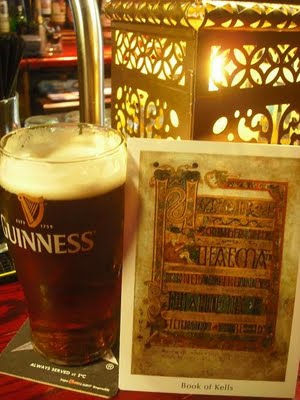
Inside, a cool, lugubrious gloom houses the 1200-year-old Book of Kells. A hushed reverence descends as you approach the glass cabinet displaying two of four volumes. If your throat feels dry in awe, think of Brendan Behan who drank only on two occasions: when he was thirsty and when he was not.


Fabulous Latin calligraphy, coupled with vivid, medieval Celtic colours depicting symbols of the evangelists, gives the impression that the print is recent. Spend a few minutes scrutinising the extraordinary attention to detail, then bear in mind that this book – thought originally to have come from Scotland for safety – was found dumped unceremoniously in a field near Kells, west of Dublin. Pretty remarkable, then, that it has survived at all.


Books, books, books

Talking of books, there are over 200,000 of them in the Trinity Library. All first editions, they span five centuries and a multitude of languages – from Greek and Latin through Old Irish and Aramaic. The smell of ancient cracked vellum pervades the air as you enter, breathing a distant past beneath the barrel-vaulted ceiling.


Four-and-a-half miles of shelving in this Long Room must surely require a complex method of codifying the tomes, no? Alphabetical? Categorical? Well, actually, the books are arranged by size: big ones at the bottom, small ones at the top. In order for a student to locate a title, they must first know the dimensions!


Good old Ireland


Oh, and there is something familiar on the left-hand side. A twenty-nine string willow harp is displayed in a glass case. Only three feet high, it is the oldest surviving Irish harp, but why is it so recognisable? If you’ve ever held a pint of Guinness, you’ll know..

I’ll leave you with a piece of advice from old Mrs. Murphy: ‘ A woman who thinks the way to a man’s heart is through his stomach is aiming that little bit too high.’ Notice I’m saying nothing about apostrophes..

A Little Something on the Way home..

Now that the U2 tour is finally over, I bumble up to Suffolk to return the truck to Transam Trucking’s yard. It’s in a small village that only just features on road maps, and where the denizens still use beads for currency. They look on with wonder at modern innovations like the pound coin.

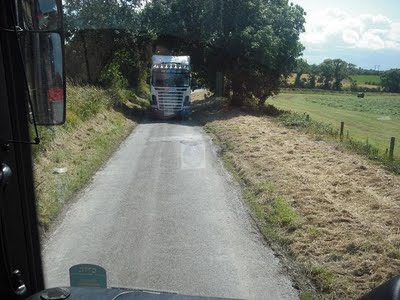
Radio Two’s signal grows ever weaker, and the roads narrow appreciably. In fact, Transam drivers have a saying: ‘If you can make it to the main road (A140 Norwich – Ipswich) from the yard, then you’ll probably be OK for the tour.’

Load of Old Rap

Before the radio fades completely, Steve Wright manages to announce that our tastes in music give clues to our personality. ‘Rap fans are outgoing,’ he says. Well, that’s news. There was me thinking that shouting to a drumbeat appealed to introverts.

Emptying the cab, and discovering the detritus from eight months’ touring – there’s a biscuit from February or March, or possibly January, behind the seats – I look forward to some peace and quiet at home.

Just at that moment a Kentish dressage champion – to be thematically consistent I may as well mention her E cup – texts with the following: ‘I am about this afternoon if you want to pop in for a cup of tea and optional stringless filth.’ Ooh, I love a girl with her own kettle. And it is on the way home..