My hometown (not that I’m there much)..

The year was 1066. Sound familiar, or did you doze through school history lessons? It ought to catapult marauding Normans to your mind’s fore. That landmark year heralded Britain’s invasion by the bloodthirsty William the Conqueror.

His landing in Hastings sparked an infamous soldier-culling skirmish, piercing King Harold’s eye with an arrow. Or so they say. Usurping the crown, William built Britain’s first Norman castle – atop the West Hill – in the following year. Now little more than a clump of stones, it overlooks the English Channel, once sentinel against pugnacious frigates. Confusingly however, the Battle of Hastings was fought six miles yonder – in Battle.

A nautical theme runs through Hastings. Nestling beneath vertiginous sandstone cliffs, the town has always relied heavily on the fishing industry. But during the Great Storm of 1286/7, the natural harbour silted up, vanishing forever. Boats have languished stoically on the shingle ever since. This is Europe’s largest beach-launched fishing fleet, and one of Britain’s oldest.

The “boy ashore” mans the winch. Oilskin-clad colleagues trudge up the pebbled shore with staunch resolve, diligently placing “troes” (wooden planks) under the weathered vessel as she inches up the stones. Chip-fed gulls wheel overhead, cawing deafeningly, and beadily surveying today’s catch. Then they swoop, adopting octogenarian posture against the scything offshore gale. Timelessly, the salt-weathered crafts wait in serried ranks, looking incongruous as amphibians. Tomorrow, rusting bulldozers will push their hulks into the sea once more.

‘Not worth opening,’ complains the miniature railway’s weathered owner. He furrows his brow, shrugs resignedly, and gazes over at the fish markets. ‘Nobody here, look,’ he adds, in an expansive gesture. He puffs dejectedly on a cigarette and throws seed to resident pigeons. Licking salty lips, I continue to look as his despondent frame shuffles off. It folds itself into a white van. Hastings attracts some quirky types.

Behind the town’s dilapidated façade, amusement arcades and chip shops, lies creativity. The tapestry of characters here is rich: some gregarious, others aloof. From the pub that brews its own beer, to eclectic live music, Hastings is packed with artists and musicians. One particular artist is so creative actually, that, at seventy years old, he has a three-year-old daughter. ‘Sorry, she’s four,’ he added. ‘Must remember that.’ Exiting the gallery last year, I remember nodding at his wife, assuming she was a daughter.

Heading home, I come to The Smugglers Caves. In the early eighteenth century, iniquitous transactions flourished throughout these dank subterranean caverns. Pious denizens slept; nefarious activities ran amok. My nose wrinkles as I pass the haunted entrance, but a waft of fresh halibut is the culprit. ‘Remember to unwrap it when you get home,’ the saleswoman had said. ‘And it’ll only need a few minutes grilled on each side.’..

Do we need vaccinating?..

I recently pitched this to the UK magazine, Wanderlust – for the “Travel Rant” page. It is now due to appear on the Letters page instead so I think I’m safe to reproduce it here:

Vaccination is big, big business. The pharmaceutical industry – a consummate master at making money – tells us that we need protecting from diseases. This is why travel articles repeatedly contain sidebars listing recommended jabs.

Of course they do; we all love hopscotching around the globe, and our health shouldn’t be compromised. But does the average traveller know what makes up a West Nile virus vaccine? Or yellow fever or typhoid?

Even a simple tetanus jab is laced with nastiness. It comprises – among other ingredients – aluminium phosphate, formaldehyde and thimerosal medium (49% mercury). These toxic medicines are being introduced directly into our bloodstreams, bypassing the body’s natural defence mechanisms. And are these vaccines even effective?

Conventional medical opinion argues that they are. In fact, those of us questioning the norm are often shot down in flames, labelled as witch doctors peddling evil heresies. But has the recent fiasco of swine flu not given rise to some doubts in the most conservative among us? The uptake of the recommended vaccination has been far lower than the government expected.

Highlighting skulduggery among powerful drugs companies isn’t my aim. But I am advocating that travellers think for themselves. Have you looked at the alternatives to vaccination? Yes, you may have to show a yellow fever certificate occasionally, but inoculations are mostly recommended, not mandatory.

Take Zanzibar, for example, currently in the limelight in Wanderlust. Last time I visited this idyllic island I was warned that the ship’s doctor would need to see my Yellow Fever certificate. So I bought one on the docks prior to sailing from mainland Tanzania – no jab needed, thank you very much.

Natural immunity is the key to protecting ourselves; simply being in good health is the best barrier to disease. Ways to reduce the risk of infection are: good nutrition (avoid toxins wherever possible), and avoiding antibiotics/vaccinations (these damage the immune system).

However, the best way to strengthen the immune system is to be under constitutional treatment from a qualified homoeopath. Otherwise, you can purchase a kit of travel remedies, taking care to carefully read the accompanying notes on how they should be taken and stored. The kits are available from www.helios.co.uk.

I would urge readers to take a look at www.campaignfortruth.co.uk. Researcher, Stephen Ransom, writes here about the damage that vaccination (as a principle, rather than individual vaccines) can do to our health. For information on the homoeopathic approach, please email susan_g_coates@hotmail.com – she’s my mum so be nice. Let’s stay healthy and focus on the travelling..


Europe on the cheap? Try Couchsurfing..

Three glasses are set down upon the table. ‘Cherry liqueur?’ offers Ivana. Oozing hostly largesse, she pours a murky liquid from a suspicious-looking bottle.

‘You always get offered an alcohol drink in northern Croatia,’ she says, ‘and it’s usually home made. If we have it, that is.’ She smiles and introduces Ben, a German traveller in his early twenties. Welcome to Zagreb, and welcome to the phenomenon of Couchsuring.

A fledgling operation in 2004, the Couchsurfing network now has over 1.6 million users.  The site continues to burgeon worldwide, but unassailably leading the statistics is Europe. Though a truly global community spanning the entire world, over 50% of Couchsurfers are Europeans. In fact, the top – or busiest – three cities are Paris, London and Berlin. Paris alone has a choice of almost 30,000 hosts; Europe is the continent to Couchsurf.

So what is Couchsurfing all about? Well, the slogan is “Creating Inspiring Experiences”. The aims include stimulating people to learn and grow, and to build a community that is inspired to seek harmony when conflicts inevitably arise. Strangers’ homes are unlocked to the weary traveller; stories are exchanged. Some hosts offer a spare room, a mattress in the living room, or – quite literally – a couch to sleep on. It’s about making connections worldwide.

Whether you are eighteen or eighty, there is opportunity to host, visit, or just meet like-minded travellers. Though the average age of Couchsurfers worldwide is just 28, the site already boasts over 1400 users in the 70-79 category and more than 300 octogenarians. There is somebody for everybody, and the numbers continue to grow exponentially – it is not uncommon for 15,000 new people to join within a week.

Simply visit the website and submit a profile. The more fields that you fill in, the more success you will have; the information you provide will give others an insight into your personality. Don’t forget to add photos.

These can be unsmiling portraits, or crazy snapshots of the night you used a road bollard as a didgeridoo. Above all, be yourself and be honest – your potential host has to make a decision to invite you into their home. They may be a little crazy too..

Some hosts, however, have no facilities but simply love to meet new people travelling through. For them, there is the option of meeting ‘for a coffee or a drink’. How nice to find a personal guide with local knowledge of a city, unhindered by tourist bureaux opening hours, and genuinely wanting to show you their environs. But what about the language barrier in Europe?

You’ll find that in Scandinavia and the Netherlands, the standard of English is generally impeccable, at least among younger people. In other European countries, however, finding English-speakers can be more difficult. This is neatly dealt with on Couchsurfing’s website – language competence is listed as expert, intermediate or beginner.

So you know in advance – before even receiving a reply email – whether their English is good enough to hold a conversation. This also applies to other languages; perhaps you could practice with a Spanish-speaker in Italy before taking a train to Barcelona.

When travelling in Europe, it’s pretty easy to whizz through countries, so to read up on all the history can be daunting. For example, when arriving in France from the UK, it is a mere 30-minute drive to the Belgian border; and from there, only a two-hour hop to the Netherlands.

To really understand these countries – or even regions within countries – you need to spend time with a local. Who knew, say, that eating horsemeat in Flemish-speaking Belgium would be frowned upon in the Wallonian region of the same country, barely an hour’s drive away.

‘Croatia invited the necktie. Did you know that? asks Ivana. She then embarks on a didactic narrative covering the history of the Balkans. Once comprising six republics, Yugoslavia has now morphed into separate countries, the most recent of which – in Feb 2008 – was Kosovo. ‘The Croatia of today was only born in 1991,’ she adds.

This has been a troubled part of the world – even today there remains hostility between Serbs and Croats – yet Ivana is an open book. She chats eagerly and happily, asking nothing in return. Her flatmate is out meeting more Couchsurfers to bring back, and I wonder how they manage to function with so little privacy in their own home.

What inspires people to invite strangers into their houses? Despite cramped accommodation, altruistic exchanges still take place with joie de vivre. Sleeping near strangers, eating together, sharing a bathroom… It’s not for everybody, but it certainly offers a better understanding of a country’s culture.

It’s not all about taking, though. Giving back can entail hosting when you return home – or, indeed, before you leave – or a simple gesture like cleaning, cooking or buying a small gift for your host. Perhaps you can present something quirky from your own country?

Or you may choose not to stay with anybody at all; if you prefer the comforts of a hotel room, or hanging out with travellers at a hostel, then why not just enjoy a coffee and an informative stroll with somebody interesting. But choose your targeted region wisely – Europe can’t be tackled in just one trip.

Worth a look:

Apparently I share my birthday – May 25th – with Towel Day. Don’t ask, just check out the link.

This is me stalling for time, by the way.  I haven’t got round to writing up the adventures in the Balkans on the AC/DC Tour yet…but they are coming. Oh yeah, they are coming.

Sri Lanka: In Search of the Perfect Cup of Tea

“What goodness Zesta?” asks my perfectly-postured waiter. He beams, almost imperceptibly shakes his head, and hovers unnecessarily at my breakfast table. Beneath a high-ceilinged veranda, the conversation has reached a stalemate.

A light breeze blows as I sip the finest cup of tea I’ve tasted so far in Sri Lanka, and I look at my attendant in his crisp white shirt. On the label of the teabag is written, “Zesta Plantation Fresh.”

My quest is to find the perfect cup of tea. Surely Sri Lanka, formerly Ceylon under the British, ought to be an excellent place for such a challenge. After all, the interior Hill Country – on an island regarded by Marco Polo as the finest of its size in the world – is replete with tea plantations.

But as I was soon to discover, the majority of the high-grade tea is exported; I was told I’d be better off drinking the stuff in London than in Kandy, Sri Lanka’s second city.

“Where from?” asks the tuk-tuk driver. “Ah, England. Very big, very strong, very money.” He drops me at the train station, for a journey east from Colombo, into the very heart of the tea-growing area.

Due to severe delays – a container has fallen onto the railway track – I have to take a bus. Several hours later, a tea lover’s dream unfolds, a vista awash with tea bushes growing on improbably vertiginous slopes. I can smell the acrid production as we pass the Waharajah Tea Processing Centre.

It isn’t the roads that are dangerous; it is the drivers. The bus driver lurches his vehicle round the hairpins, inches from a DAF truck’s bumper, filling the bus with black exhaust. On a particularly lethal bend we overtake, only to pull in seconds later to allow passengers to board. The truck plods past once more. Round the next bend is a bus on its side, ten feet over the precipice. Yet we continue to accelerate down hills, braking harshly.
Tea bushes grow on ‘improbably vertiginous slopes.’ in Sri Lanka.

Arriving in Dalhousie is a relief. I order some soothing tea at the Wathsala Inn, relaxing on a balcony affording a fine view of papaya trees and Adam’s Peak. Known locally as Sri Pada, the mountain’s summit is reputedly marked with the indentation of Buddha’s footprint.

“Start walking to the top at 2:30,” says Nimal, the hotel manager, adding far too much hot milk to my tea, and serving from a stainless steel pot rather than china.

With more than 5,000 steps to ascend before sunrise, I need some calories. But I can’t decide between a “plane” omelette and “sessional” vegetables from the menu.

“If it is raining, there will be leeches,” warns Nimal, eyeing my flip-flops as I deliberate. “I can lend you tiger balm if you want.” Under a perfect Orion constellation, precipitation looks unlikely.

At 3 a.m., pilgrims are already descending; they have rung the summit bell, and are uninterested in witnessing the sunrise. Having overtaken a tourist or two, I stop at the first tea stall en route, illuminated by dim streetlights.


Prayer flags flutter in the wind.

A foul drink called Nestomalt is served, advertised as tea. The quest for the perfect cuppa is rapidly falling into abeyance.

At 4 a.m., the summit doesn’t look too far away; I have time to warm the throat once more. “Come here,” calls a tea vendor, displaying a poor but effective sales technique. Bustling industriously with a broom, he is wearing a black flying hat with earflaps, and pink-and-white material round his neck – like an oversized tea towel. He watches while I sip his odd-tasting beverage, a curious mix of both tea and coffee.

At 5.30 the sky lightens. Prayer flags flutter in the wind; musicians appear in procession. Pilgrims pray as the sun rises ever higher. Behind the peak, a triangular shadow of its bulk is reflected onto the clouds beneath; the ethereal silhouette is a perfect isosceles.

Returning to my hotel, a labourer is in my shower, holding half a coconut filled with cement. “Damage in your bathroom,” he explains. He diligently dabs at a crack in the tiles, using a splinter of palm tree as an effective makeshift brush. With the shower evidently out of action, it seems a good time to visit Laxapana Tea Plantation, only about a hundred yards from the hotel.


Tea pickers with their baskets

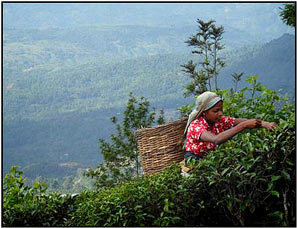
Walking uninvited up the long drive, Tamil women smile shyly, barefoot and in rags. Beautiful, and vibrantly dressed, they somehow blend with their surroundings, as though they have sprouted from the tea bushes. “Bye bye,” they call, waving hello from beneath their bright headscarves.

I stop and watch, as they appear to float across the bushes. Picking with both hands, the elbow remains still; only the forearm is lifted as they grab the leaves upwards (think of milking a cow and simply reverse the action).

When their hands are full with leaves, they reach behind their heads, dropping the harvest into weaved cone baskets on their backs. These baskets, containing between 5-8 kilograms (10-15 pounds) of leaves, are secured with a strap around the forehead.

The women form two patient queues at the weighing station, tipping their leaves into one of two baskets hanging from scales. Plastic wallets like passports – with only a single sheet of paper inside – are handed over.


La-la the tuk-tuk driver

The weight of leaves is noted; the wallets are tossed casually into the empty baskets. The leaves are then stuffed into onion-like, red string sacks, and loaded into a Mitsubishi truck that roars off over the hill. The women disperse, each holding a six-foot long bamboo cane.

A Sinhalese supervisor lays aside his clipboard and borrows a cane, placing it on the nearest tea bush. He demonstrates that the leaves jutting above the cane can be picked.

“In six days, pick again,” he says. “There are 135 tea factories in Sri Lanka,” he adds.

Travelling east to Haputale, I can see why there are so many – tea fills my field of vision in every direction.

At 5:15 a.m., a torch shines into my eyes. A tuk-tuk driver called La-la is taking me to Lipton’s Seat for sunrise, a viewpoint ten miles from Haputale by road. Peering from behind thick flaps – stuck with Velcro to the sides of the tuk-tuk – I can see dark clouds coalescing over the Poonagala hills.

“Very clear day,” says La–la, with misplaced élan, no doubt angling for a tip. He has already hinted how expensive petrol is.

Lipton’s Seat, named for Sir Thomas Lipton

We bump up a tortuous, unlit road riddled with potholes, slowing at a police checkpoint to show my passport in the inky light. Even in first gear, the engine coughs as we climb higher, passing bungalows clinging to the precipitous slopes as though affixed by glue.

Dawn breaks over the country that Sir Thomas Lipton, the infamous tea magnate, described as a “lovely and delectable island of spicy breezes.”

The sun has already risen as we reach a locked barrier, and there is still a mile to walk. But the stupendous panoramic view from Lipton’s Seat is worth every step.

This is the highest point of the mountain range, and Sir Thomas was renowned for sitting here, surveying his bounteous plantations. Fifteen minutes later, a villainous fog rolls in, sucking any warmth from the sun.

With La-la long gone, I amble back along the road, through the beautiful rambling tea estates. The punishing sun soon punches through the mist, illuminating a magical landscape, like a religious portrayal of rays from Heaven. One woman is washing spring onions and turnips in a waterfall; another is hurrying barefoot, burdened by an enormous bundle of sticks on her head. Her gait is a cross between a walk and a run.

Carrying firewood in Sri Lanka

Tea workers begin to appear, taking steep, rocky shortcuts through the bushes en route to Dambatenne Tea Factory, a vast edifice built by Lipton in 1890. I follow them, encouraged by smiles, entering via the Staff Entrance. In the Fermenting Room a sign reads, “No Chewing Betel.”

For a modest fee, Anuba gives me an individual tour of the entire factory, beginning at the deep troughs upstairs. Here, the tea leaves are continuously heated for twelve hours, to remove 45% of the moisture.

A worker squats with a broom, sweeping the now withered leaves down a hole to the next stage of their processing journey. They are crushed, shaken, filtered through a mesh, fermented on the floor, and heated to 260 degrees F until only 3% moisture remains. At the end, there are eight different grades of tea.

“First two grades export to UK, China, Japan, Europe and Saudi Arabia,” Anuba says. He laughs. “In Sri Lanka, only drink bad tea.” Remarkably, the tour is winding up without any suggestion of actually sampling the product. Despite finishing in the Tasting Room, perhaps it is not worth his time on just one person. I’m disappointed.

A tea plantation in Sri Lanka

From Dambatenne there is a choice of a public bus back to Haputale, or a bus laid on for the factory workers. Both are attractive options, full of interesting people able to speak English, but today I’d rather walk the remaining five miles. First, though, I need a revivifying cup of tea.

In the café across the road – in a collection of houses built as workers’ quarters – I place my order. When brought over, the tea has body, but no discernible flavor; this is low-grade tea.

Real flavor comes from tea grown at high altitudes, tea that has been packaged and shipped to my local supermarket in England. It seems my perfect cup of tea may well be the one I drink when arriving home from the airport.

Barnaby Davies

By Barnaby Davies
Published in Gonomad

Barnaby Davies has written for Trucking Magazine (print), bootsnall (online) and theexpeditioner (online). As well as writing articles, 2010 will see him touring Europe as crew for Metallica, AC/DC and U2. He is happiest barefoot and as far from a television as possible.

Trainspotting: Sri Lankan-Style

“The train officially leaves at 10.30 a.m., but it will be late.” Nimal, the manager of Wathsala River View Inn in Dalhousie, beams knowledgeably. “It is always late,” he adds.

In the background, Adam’s Peak, an important pilgrimage site, looms imposingly at 7,360 feet. The air is clear and tranquil this morning, punctuated only by the roar of the river and the thwack of a cricket bat on the main road.

At 9.05 a.m., the 9:15 a.m. bus service to Hatton station sails past. Then a passing tuk-tuk slows, offering to catch up with the bus for an inflated fee. Round the next bend — a distance of no more than 300 yards — the bus is taking a ten-minute break.

But it is not a direct service to Hatton, this bus is actually only going to Maskeliya. In the dusty square that passes for this town’s center, time is ticking towards my train’s departure time, and there is little evidence of an onward bus.

I nonchalantly approach another tuk-tuk driver, as though haste is the furthest thing from my mind. This keeps the price down, but the quoted sum is 20 times more expensive than the bus. Still, it is very reasonable for a 12-mile journey through stunning tea plantation scenery, stopping briefly for photographs whenever I like.

One notable idiosyncrasy of tropical transportation, however, is that tuk-tuks tend to contain little fuel until a customer needs a ride. As we fill up in the garage, a Hatton bus — with many open seats, no less — drives past, enveloping us in a cloud of black exhaust.

Struggling up the hairpins lined with tea bushes, I look forward to making some progress on the imminent downhill stretch. We crest the brow. Yet, rather than overtake the bus, my driver switches off the engine.

It seems we are to freewheel down hills to save the fuel that I’ve just paid for. This economical technique, while admirable, proves laborious: the fierce twists, and sections of level road, slow us down considerably. In fact, one stretch of tarmac sees us almost at a standstill; the engine is briefly fired up, powering us to the next slope.

We serenely descend through verdant Hill Country, passing a man washing his silver minivan in the shade. Next to him is a sign marked, “Vehicle Washing Prohibited.” He smiles and waves from beneath a tree.

Finally, we pass the bus and pull into the station. “Train station, not bus,” I point out, eyes fixed on the driver’s strapless Casio watch stuck to the dashboard. But the tuk-tuk engine won’t start, and we begin to roll back towards Dalhousie for the next four minutes. The bus drives by again.

Dropped at the train station by the third tuk-tuk of the morning, I note the time: the station clock reads 10:32 a.m. “The 10.30 train to Ella?” I ask apprehensively. “Maybe 11.30,” replies the railway policeman, and gives directions to the nearest café.

The station facility, marked “Restaurent — Quality Toffees and Sweets,” looks as if it has been closed since the British left.

Also looking as though it has been abandoned is the footbridge that leads over the tracks. Though in perfectly good order, it is now simply decoration, used by none of the passengers.

Even the peak-capped railway staff, in starched white uniforms, hop happily onto the tracks when crossing between the platform offices. Just after midday, passengers begin to mill nonchalantly across the track. Something must be happening, I think.

At 12:05 a.m., the 10.30 a.m. service to Ella pulls in. For this spectacular journey — less than 50 miles, yet due to take four hours — I have bought a ticket for the Observation Lounge, a carriage at the rear of the train. But what is slightly annoying is that there are only four good seats: the ones looking through the rear window.

To add insult to injury, two of these seats are occupied by sleeping children. I opt for hanging out of an exterior door instead, between the compartments. With health and safety wonderfully absent in Sri Lanka, this is a trend shared by plenty of fellow passengers.

Munching on a prawn patty bought from a platform hawker, we enter a tunnel. Screams of childish delight echo throughout the carriages, as does a ripple of coughing from the veil of trapped diesel fumes. The temperature cools considerably as we climb higher through Eucalyptus Forest, passing a marker indicating 4,803 ft above sea level. My co-passenger, a Sinhalese Guard, lights a cigarette in the Luggage Van.

The temperature continues to drop as we rise. Neat gardens of carrots and cabbages grow alongside the tracks now, and there are fewer palms. We pass Pattipola at 6,204 feet — almost the highest point on the track– and enter a long tunnel. The passengers’ enthusiasm for resounding whoops is still keen: even after 28 other tunnels, they still shriek when plunged into darkness.

Eventually arriving in Haputale, I try to find out about whale-watching trips — I’d read that they operated out of Mirissa on the south coast. Loga, an internet café owner, comes to my aid. “Whale? It is animal?” he asks. “Ah, I know, it’s bigger than elephant.”

His attention then returns to his beloved internet dating site. At 35, it is socially frowned upon to be unmarried here, a predicament I had discussed at length with Nimal back in Dalhousie.

One of the first questions a Sri Lankan will ask is, “are you marry?” The idea of willingly remaining single in your thirties grates harshly with their way of thinking. The problem for men is that, on reaching the grand old age of thirty-something, there are few available women of the same age. I notice the rather overweight Loga has listed himself as muscular in his profile. (He’s also listed himself as having “blue eyes,” an outright lie.)

Just before 7:00 a.m. I hear a hoot, announcing the departure of the 5:09 a.m. mail train to Badulla, the end of the easterly line. But I’ve decided to ride five miles west first, to Idalgashinna, for a leisurely walk back along the tracks. In fact, this is an advertised walk, embarked upon by numerous travelers clutching Lonely Planet Guides. I take care to “buy a ticket before entering the plateform,” while locals choose to hop up onto it from the rails. Needless to say, the train is late.

In Idalgashinna, barefoot children soon join me for the first mile of the walk, brandishing sticks and laughing. Sometimes there is a path, and sometimes my strides are dictated by the gaps between the rail sleepers. Smiling Tamil women bob above the tea bushes, picking leaves speedily, framed by a spectacular view.

A blue and black butterfly dances over the weed-strewn sleepers in front of me as I catch up with some railwaymen. One worker is lackadaisically adjusting nuts with an enormous spanner; the other is carelessly applying oil to one of the rails as he walks. Sauntering lazily along the tracks at Glenanore, I notice a sign: “TRESPASSERS ON THE RAILWAY WILL BE PROSECUTED.”

The barriers are down at Glenanore, presumably in preparation for a train coming through. “Trolley, not train,” clarifies a member of the staff, as a clattering noise pervades the quiet.

The trolley turns out to be a real Wild West affair, operators leaning and pulling on a lever to get it moving, and turning a long T-shaped bar to apply the brakes. The contraption promptly grinds to a halt and ten Sri Lankans beckon me to hop up and join them for the rollercoaster ride down into Haputale.

Thanking my newfound friends for the lift, I double-check that the 11.25 a.m. train to Badulla is running late. Yes, as I had suspected, it is now scheduled for 1:00 p.m., which also turns out to be an optimistic estimate. But I’ve grown to love these almost meaningless timetables.

The trains usually reach their destination each day; it’s just a question of when. Chatting once more on the “plateform,” a friendly railway worker says, “Big delay. Maybe 1:20 p.m.” To be honest, that’s fine. The sun is shining, I’m making new friends, and I have food and a book. I expect it to come at 2:00 p.m.

By Barnaby Davies
Published in the Expeditioner.

How to Make Sure Your “Budget” Airline Ticket Really is a Deal


Airline tickets on low-cost carriers can be extremely cheap at first glance. But that’s before the addition of a cauldron of hidden expenses that can ensnare the unsuspecting traveler. Paying for your flight, for example, should not be an “optional extra”. The good news is that you can avoid these add-ons. With a little inside knowledge – and time – it is possible to travel for the advertised price of a cheap flight.

The key ingredient to cheap flying is flexibility. Can you move your travel dates a few days either way? Do you really have to go to Berlin on certain dates, or will Belfast/Bratislava make a satisfactory substitute? Or could you fly into another German airport and take a train up to the capital from there? If you can, there will be a rock bottom fare in there somewhere.

The following tips are specific to Ryanair, because this airline operates the really dirt-cheap flights in Europe. However, the format of adding extra charges is more or less the same for all the no-frills airlines. Adapt slightly, and these tips are applicable to any low cost carrier in the world.

The internet is your friend.


Always book your tickets online. Do this even if you are paying an hourly rate in an internet café. Budget carriers charge – sometimes extortionately – for telephone bookings. It is not the case that the earlier you book, the cheaper the flight. In fact, booking three months in advance is generally more expensive than waiting for the upcoming deals. So it is a question of balancing price with peace of mind.

Subscribe to the carrier’s email newsletter. You will receive frequent emails keeping you up to date with offers and promotional fares. However, if you haven’t had an email it doesn’t mean there are no bargains to be snapped up. Flight prices can change daily.

Study the routes. Maybe you can fly cheaply into one airport, and out of another one nearby? Spend some time on the carrier’s website and play around with your options. And do not forget to check in online and print out your boarding card. You will get a reminder email to do this, so there is no excuse. It is far, far cheaper to pay to print this document than turn up at the airport without it. (See “Ryanair fees” for Airport Boarding Card Re-issue.)

Don’t get caught exceeding the luggage limits.

On the homepage, click on Ryanair fees. This gives you a simple chart of add-on charges. See how a second checked-in bag rockets the price? If traveling with a lot of luggage, it can be cheaper to avoid budget airlines altogether. This particularly applies if you’re taking sports equipment, musical instruments, or lots of gear for your kids.

Do you really need a huge suitcase for a three-day city break? Hand luggage is free, and the permissible weight is 10kg. Do not risk exceeding it; this will very quickly amount to more than the cost of the flight. If you’re not sure how much luggage you will have, don’t book the flight just yet. It is far cheaper to add luggage to an online booking than to turn up with extra weight at the airport.

Weigh your luggage on a scale at home. If that isn’t possible, most airports now have a machine at the entrance that weighs luggage for a modest charge. If you’re feeling cheeky, use the built-in scale at an empty airline desk. According to http://flightchecker.moneysavingexpert.com, even if the desk is not staffed/open, it should still work. If your bag is too heavy, consider wearing some of your packed clothes.

Carefully note the hand luggage maximum dimensions. Go fractionally over these figures and the bag will have to be put in the hold. Negligence may have just cost you $23. Compare that to the cost of the flight, which may only have cost $10.

Eliminate the extras.
fees

When you’ve found a cheap flight and begin to book, many of the boxes for extras will already be ticked. Start unticking them quickly! For a start, can you take off the charge for a checked-in bag, which appears automatically on the booking page?

Unless there is a good reason for priority booking, take this off too. What are you paying extra for? Is it better to be cooped up on a plane, or milling about in the departure lounge for an extra ten minutes? European flights are rarely more than a couple of hours; it’s not as though you’re flying long haul to Sydney.
There is a field for travel insurance cover. If you’ve already flown to Europe, you’ll no doubt have a policy. Choose “no travel insurance required” from the drop-down menu. You also don’t need the option of flight information to be sent by text message for $1.50.

Online or Web Check In is often waived on promotional flights, so check these offers first. If you are flexible with dates, it is possible to avoid this charge. If you remove all of the extras, and it is a promotional offer with no taxes, the amount now due will be exactly the same as the original cost of the flight.

Watch out for “hidden” fees

You will always be notified of taxes at the beginning of the booking process. Some flights will initially look more expensive but have little or no taxes; some will look cheaper but be subject to higher taxes. Either way, you will know within a click or two. These are not hidden extras that crop up at the end of the transaction.
What does crop up, though, is being charged to pay for the flight. This is where all the budget carriers make some pretty easy money. Apply for a Mastercard Prepaid Debit Card, however, and you’ve found the loophole on Ryanair. You can pay for free using this card; any other method is subject to an $8 booking fee per person per flight. Yep, this can soon add up when booking return flights or traveling in a group. You can apply for a card online, and load it with funds online. (For Easyjet, the loophole card is Visa Electron. N.B. Non UK Cardholders transacting on the Easyjet website may be subject to a cross border fee applied by their Card Issuer.)

When booking online, you will see, “excluding administration fee (if applicable)” next to the total price. I have never seen this fee actually applied to a flight. Don’t worry about it.

Book return flights as two separate singles. This is because Ryanair will sometimes change the departure time of a flight, and ask you to accept or decline the alteration. The decision will affect both flights, so you may lose a great one-way price back from a destination, and have to rebook the same journey at a higher price (after a promotional offer has expired). If you accept, they will refund the cost in full.

Budget flight websites are a minefield and a rock bottom fare can easily end up costing double or triple what you thought it would. But if you have enough time, scrolling through all the deals will pay dividends. Just avoid all the extras and watch out for hidden fees and you can score a dirt cheap flight for the advertised low price.

By: Barnaby Davies

Published in Boots’n’All

Photos by Roubicek, cranium, chris1h1

Time (Zone) Travel: All Thanks to Longitude

‘Dinner at 7?’ asks my colleague. Beneath us, the Superfast Ferry eases into the Ionian Sea from its Mediterranean berth.
‘Greek time or Italian?’ I query. ‘Or are you being insufferably obdurate, and remaining on UK time?’


I wonder if it is only British people who choose not to adjust their watches when travelling.
London – or nearby Greenwich, to be specific – is, indubitably, the hub of time. It is the prime meridian, the spot at zero degrees longitude where East quite literally meets West. So perhaps the British obsession with the time at home is understandable.
As we steam towards the Adriatic Sea this evening, from Patras to Ancona, I drain the dregs of Chianti and attempt to set my alarm clock. But, simply put, I’m not sure what the time is. What is time anyway?
Well, it is inextricably linked to longitude, for a start.
Charting the world’s longitude was no mean feat. We can now stand anywhere in the world – whether atop Mount Kilimanjaro or floating above the Geographical North Pole – and know our coordinates within a fraction of an inch. Although, at the North Pole it can be any time you would like – it is every time, all at the same time! In fact, you could very reasonably have breakfast, lunch or dinner there, or all one after the other for that matter. Time ceases to exist at this northerly latitude.
Eighteenth century mariners may have cared little for the hour as they plied the world’s oceans, yet they misjudged landfalls as regularly as clockwork. Myriad maritime disasters dogged the finest of admirals; without accurate longitude – and therefore time – risks were high. Nowadays, of course, we take GPS and time zones for granted. We know the exact time in New York, Paris and Singapore, yet modern day travel is not without its time-associated problems.


Early explorers could never have dreamed of jetlag, though Vasco da Gama and Captain Cook – to choose two infamous pioneers at random – travelled far more of the world than most of us have today. Sailing within temperate zones – with clear distinctions between daylight and darkness – offered a regular sleep pattern, at least among the officers.
Nowadays, with electricity and air travel, are we totally out of kilter? Darkness no longer necessitates sleep: we have artificial light and unnatural working hours. And we’re advised to sleep at “normal” times in the places that we arrive, no matter how many hours spent sitting uncomfortably on an aeroplane. Our bodies tell us it is midnight, yet our wristwatches read mid-afternoon. The man to blame is John Harrison, that lone genius who grappled with the thorniest scientific problem of his time – that of longitude.
Harrison’s ingenuity and craftsmanship changed world travel forever. A carpenter-cum-clockmaker, he solved the enigma of longitude, creating an accurate timepiece to withstand the stormiest of seas. By always knowing the time in London, coupled with skilled navigation, sailors now had a reliable means for establishing their whereabouts. Thus longitude was grasped, and world time established.
The West is now obsessed with time – if you are reading this, do you have one eye on the clock in the bottom right-hand corner? Maybe you have coffee at 11, or lunch at 12.30 on the dot? Let me ask this: are we more content than the rice-paddy farmer in Laos? He functions perfectly well without the need for a watch: when it is dawn, he must toil the fields; as dusk descends, he stows his hoe and rests. Clocks around the world, changing back and forth twice a year, make no impact on this timeless way of life.


But for the rest of us, an hour forward or back can cause bedlam. You’ve just missed that train to Philadelphia, or that bus to Boston left fifty-five minutes ago. And that’s just within the same time zone! Throw in international travel, and time issues can become farcical.
‘Italian time,’ replies my colleague, circumspectly. ‘The ship is on Italian time.’
I rewind my watch an hour behind Greek time, turn out the light, and pretend it is midnight instead of 11pm. Mentally, this helps me to sleep.
Maybe when I return home, I will try a day without looking at a clock even once. Could you? Try eating when you’re hungry and sleeping when you’re tired. Somebody, somewhere in the world will be doing the same thing.
By: Barnaby Davies

Published in BootsnAll

photos, top to bottom, by: leoplus, taiyofj, arvindgrover

5 Reasons To Add the Shetland Islands to Your Europe Itinerary

At Sixty degrees North, they are literally the UK’s “Top” islands.
The Shetland Islands aren’t just ponies and Fair Isle sweaters. Shetland is a
magical, ice-carved archipelago thriving in the North Atlantic, with a unique
history and culture. And with its northerly latitude, Shetland can enjoy up to
nineteen hours of sunshine in midsummer. The twilight in this month is referred
to as the “Simmer Dim.”
But what truly justifies the 12-hour ferry journey from Scotland?

1. Scenery & Walking

Shetland harbour

Scenery: Walls Harbour

Shetland’s coast is spectacular yet varied. From vertiginous, storm-ravaged
cliffs to sheltered beaches of pristine sand, Shetland has it all. And with
nowhere on the main island further than three miles from the sea, the coast is
where you will spend most of your time. Some of the finest walking in Europe can
be found here. And because Shetland is part of Scotland – and has been since
1468 – there are no laws of trespass. It is perfect for walking.

Make your way quite literally to the island above all others – to Unst, the UK’s
most northerly island. Be sure to pause at the infamous bus stop on the main
road, which has become progressively more luxurious and quirky. This much-loved
bus stop began with just a comfortable armchair, but now houses a computer,
television (no electricity though) and even fresh flowers. On last inspection,
there were even some bright pink shoes in a drawer. You cannot miss it; there is
only one road! From here there is a panoramic view.

For those that love reaching the top of a mountain, or the end of a road,
continue to Hermaness. From here it is a three-mile walk to the end of the UK –
well, almost. On the most northerly hill in Britain, you can gaze over the small
rocky island of Muckle Flugga to Outstack, Britain’s northernmost point. But you
can’t actually walk to it. What you can do, though, is consider the charming
folklore behind Outstack. The rival giants Herma and Saxa, battling for the
attention of a mermaid, are said to have hurled rocks at each other, one of
which landed in the sea.

The giants then set off to follow the mermaid to the North Pole. But both of
them drowned because they couldn’t swim! Gazing in their wake, the expanse of
Atlantic lies before you: to the north is the Arctic, to the west is Greenland,
and 200 miles to the east is Norway. But wait, there is a sound carried by the
wind…

2. Wildlife

Sumburgh Head

Wildlife: Sumburgh Head

Over 17,000 breeding pairs of gannets shriek noisily at Muckle Flugga – it is a
twitcher’s paradise. But they are not the sole ornithological draw on the
archipelago, not by a long shot. For those seeking cute, inimitable puffins –
Shetlanders call them “tammy nories” – they can be found in numerous coastal
areas; in Hermaness, between May and September, you can see 25,000 of them in
one fell swoop. Iconic Sumburgh Head, a stone’s throw from the airport, also has
cliffs littered with puffins, as well as kittiwakes, razorbills, guillemots and
fulmars. Seabirds-and-Seals offer expert boat trip tours around one of the many
seabird colonies.

The eastern island of Fetlar, with its fertile soils and green landscape, is
known as “The Garden Of Shetland.” And it is home to 90% of the UK’s breeding
population of Red-necked Phalarope. Each summer, these stunning, charismatic
little waders have visiting ornithologists jumping for joy. But if you’re coming
to Shetland seeking birdlife, watch out for the “Skooty Aalins” (Arctic Skuas)
and “Bonxies” (Great Skuas) dive-bombing the unwary visitor! Nesting areas can
be a like a scene from Hitchcock’s The Birds – it may be worth carrying a stick.
Perhaps you’re more interested in mammals than birdlife? Well, “selkies” (seals)
are to be found in many of Shetland’s “voes” – long, narrow sea inlets, found
all over the archipelago. Often, sitting with a thermos flask on a remote beach,
a grey or common seal will raise its head only a few yards away. They can also
be found snoozing in the sunshine, hauled out on headlands all around Shetland.
Sea otters, too, sometimes play along the beaches.

Because Shetland lies close to the European Continental Shelf’s edge, the water
is nutrient-rich, providing a diverse and dynamic marine environment. Harbour
porpoises (“neesicks”) frolic in the sea, as do Minke whales, Humpbacks and
killer whales. Maybe you will be lucky enough to see the latter while taking one
of the regular ferries between the eight served islands. May-September is
optimal for whale sightings.

3. Crafts & Culture

Jamieson's Mill

Crafts and Culture: A Factory Tour of Jamieson’s Mill

Knitting is probably the best-known craft in Shetland. To that end, one animal
you will certainly see plenty of is the sheep, an important island resource (and
road hazard). Shetland sheep have exceptionally soft fine wool, used to produce
gossamer lace, the famous Fair Isle knitwear, and fine tweeds. It is well worth
taking a tour of the only mill on the isles.
From 17th – 20th June, Flavour of Shetland is held, a four-day festival of
Shetland music, craft, culture and food. Be sure to sample the fresh fish and
seafood on display, as well as unusual specialities such as seawater oatcakes
and Shetland Black potatoes.

Although Scotland annexed Shetland in 1468, Scotland is spoken of as just
another country that makes up the United Kingdom. Shetlanders are Shetlanders –
an island nation, a people apart. Kilts and bagpipes do not play a part in the
culture here. No, the influence is more Norse than Scottish. After all, Shetland
was the first geographical landfall for 9th century Viking longboats. However,
English – well, a version of it anyhow – is now widely spoken. And no trip is
complete without a tale or two from one of Shetland’s outstanding storytellers.
Get two Shetlanders ’spaekin Shaetlan’ (speaking Shetland) together, however,
and you may need a little assistance in deciphering the gist. Storytelling,
traditional arts and crafts, music and dance all play an important role in the
lives of Shetlanders. The only way to find out is to come and meet them! Will
spooky stories of nocturnal goblins or “nuggles” (mythical water-horses that
live under watermill streams) frighten you?

4. Music

Shetland music

Music: Performers at a Shetland Wedding

Hardly a day passes without some sort of musical event in this vibrant
community. And again, Norse influence is strong. Country dances and impromptu
traditional sessions often take place, but there are a couple of major festivals
too. Celebrating its 30th anniversary this year, the UK’s most northerly Folk
Festival will be held 29th April – 2nd May. For those arriving by overnight
ferry from mainland Scotland, the party starts on the 28th!
Violin playing is known as fiddling in Shetland. And one of the best times to
visit is during Fiddle Frenzy, held 8th – 15th August. This festival is spread
across the islands, and offers a chance not only to witness some outstanding
fiddling, but to join a fiddle school during the day as well. Visitors can
grapple with basic technique on Shetland’s most famous instrument, and learn of
the culture and traditions that surround it.

2010 promises to be a special year – it is the centenary of the birth of Dr Tom
Anderson, a man who saved and moulded the Shetland fiddle scene we know today.
It is also the 50th anniversary of the Shetland Fiddlers. Fiddle playing in
Shetland can be traced back to around 1700, and falls into three categories:
listening tunes, ritual tunes and dance music. This is the year to try out your
musical aspirations in a nurturing environment.

5. History

Shetland historical artifacts

History: Shetland is dotted with historical artefacts.

There are a number of very important archaeological sites in Shetland, one of
which is thought to date from 4000 years ago. This can be found near the
international airport, at Jarlshof Prehistoric and Norse Settlement, a complex
of ancient settlements within three acres. Beginning with a Bronze Age village
of oval stone huts, we slide through the epochs to an Iron Age broch (fortified
tower). More recently still, there are remains of an entire Viking settlement, a
medieval farmstead and a 16th Century laird’s house. The Jarlshof name comes
from Sir Walter Scott – his novel The Pirates was inspired by the site.

Also in the south of Shetland is the finest of Scotland’s 500 or so Iron Age
brochs. Remarkably well preserved due to its isolation – in fact, it is the best
preserved broch in the world – Mousa Broch stands at a height of over forty
feet. Taking the ferry from Sandwick, across to the island of Mousa, is half the
fun of visiting. You can climb to the top of the tower between the two, thick,
stone walls. Torches are provided in a box at the entrance – it is darker than
you would imagine!

One place you really shouldn’t miss is St. Ninian’s Isle, reached via one of the
very best tombolos in Europe. This is a spectacular bar of golden sand,
traversable at all but the highest of tides, leading to the ruins of a 12th
Century chapel. A hoard of 8th Century Celtic silver was found underneath in
1958. The buried treasure is now stored in Edinburgh, but replicas can be found
in The Shetland Museum.

How to Get to the Shetland Islands & Where to Stay

The Shetland Islands are remote. There’s no way of getting away from that fact,
but that doesn’t mean they’re inaccessible. Nightly ferries ply between
Shetland’s port of Lerwick and Aberdeen on the east coast of Scotland. Boats
also leave from Scrabster in northern Scotland via the Orkney Islands. Flights
to Shetland leave from Glasgow, Edinburgh, Aberdeen or Inverness.
On arrival, it is certainly possible to travel to all the inhabited islands by
public transport. There are bus services combined with ferry services, but it
may be an adventure and require some planning! You can also hire a car,
available for collection at both the airport and ferry terminal.
How cheaply can you stay in Shetland? Very, is the answer. There is a network of
eight “bods”- buildings once used to house fishermen and their gear – at the
time of writing, but you will need your own bedding. Managed by Shetland Amenity
Trust these unique historical buildings offer a real budget option. They range
from £6-£8 (without or with electricity) per person per night. Check out
camping-bods.com for more details.

A good budget place to start, though, is at the Youth Hostel in Lerwick, a
fifteen-minute walk from the ferry terminal. There are a number of accommodation
options in Shetland, but for those that really want to push the boat out,
consider staying in one of the lighthouses. This is not cheap, but with a group
of up to six people, it is affordable, and offers unrivalled views of some of
the most dramatic scenery in Britain.

By: Barnaby Davies

Published in BootsnAll

photos by Barnaby Davies and may not be used without permission

Speed cameras are dangerous..

Speed cameras in Germany are lethal. I suppose they are called “safety cameras” nowadays, which, frankly, is a misnomer. Ostensibly to save lives, the orange flash frightened the living daylights out of me; there was a violent swerve and spilt tea. Could I sue the German government? After all, emasculation from scalding tea is not a laughing matter. I mean it – stop laughing.


My argument may not be impregnable, however; there is quite possibly a legal school of thought that frowns upon sipping a steaming cuppa whilst at the wheel. Perhaps I’ll just grin and bear the discomfort. Hey, I bet you’re surprised that we were travelling fast enough to trigger a camera in the first place? Ah, well there are roadworks on the Bremen – Hamburg motorway, and we’d been diverted through a hamlet or two.


So there we were (Namibian and Yours Truly) pottering along, minding our own business – at 90km/h through a 70km/h village – and Bam! I was lit up, startled and partially blinded. It was a little while before I could focus on a crossword again, let alone recover from scarred thighs. Luckily, I was in a Left-hand drive; Cowboy, with an ordinary British RH-drive truck, was still squinting a day later, but that might just be because he sits in midday sun without any shades on.

Now you would think after quite such a flash that Namibian might have backed off a bit. No, I’m afraid not. He was just wondering what the sun was doing up at 2am when Bam! He was flashed, too. In fact, speaking to the rest of the AC/DC drivers later, every one of us has been subjected to the curious orange phenomena found on northern Germany’s minor roads.


The good news is that, more than nine months after the event, nothing has come through the post. Well, not nothing – I’ve had bills and fan mail, obviously – but nothing connected to razzing it through German villages. My fears have been allayed for the time being, but could the sinister authorities be lulling us into a false sense of security?


Perhaps the Germans are waiting at the border for those twenty-nine truck registrations to return – a callous, calculated ploy to precipitate a crisis in rock and roll trucking. We could be incarcerated; the trucks could be impounded. As it happens, we’re all setting off again  – on 7/4/2010 – heading for Oslo to start the Metallica tour. And guess which country we’ll be transiting? Cunningly, in case the above suspicions bear fruit, I’ll be in a new truck. Ha ha, that’ll fox them.